Designing a home workout program is not about copying workouts from social feeds or arranging random sets and reps. It is a craft that blends assessment, client lifestyle, equipment constraints, sound programming principles, and ongoing adjustments. I have written dozens of plans for people who moved home, those who travel for work, new parents who cannot leave the house, and clients who prefer the privacy of their living room. What follows is a practical walk-through of how a gym trainer converts gym-centered knowledge into a safe, effective, and motivating home program.
Why the process matters
A plan that looks good on paper but ignores the household dynamic, commute, or work schedule will fail. I have seen technically excellent programs abandoned within two weeks because the client did not have room for a barbell, had a toddler who interrupts sessions, or could only train in short 20 to 30 minute blocks. Designing for reality increases adherence, and adherence is the single biggest predictor of progress.
Start by assessing the person, not just the fitness
Assessment begins with a conversation and a quick movement review. The conversation covers goals, work hours, sleep patterns, previous injuries, and the kinds of workouts the person enjoys or loathes. The movement review checks spine control, single-leg balance, overhead mobility, and pain-free squatting or hip hinging. If a client has a history of low back pain and cannot hinge properly, I do not program heavy deadlift variations even if their goal is "get stronger." Instead I fix the movement first with low-load progressions and coaching cues.
A meaningful assessment also captures constraints. How much floor space exists? Is there a quiet hour or two when workouts can happen? What equipment is available this week, and what can be purchased within a reasonable budget? A weighted kettlebell, one adjustable dumbbell, and a resistance band open far more programming options than bodyweight alone, but bodyweight training can be extremely effective when done intelligently.
Core components of a home program
When I build a program, I always include these five elements. They are not separate days in every plan, they are threads woven through weekly work to keep progress well-rounded.
Movement quality work that addresses mobility and top-end technique, done as warm-up or separate sessions Strength-focused sessions that use relative intensity and progressive overload, even with limited equipment Conditioning that improves work capacity without demanding special machines or long runs Recovery practices, including sleep hygiene, mobility routines, and low-intensity movement on off days Skill practice for specific goals, such as pull-up progressions, kettlebell swings, or running formEach component receives priority according to the individual's goals. A parent returning to lifting after pregnancy will need more movement quality and gradual loading than a former competitive athlete rebuilding strength.
Turning constraints into design choices
Equipment and space limitations force choices that clarify trade-offs. A single pair of adjustable dumbbells can produce significant strength gains through unilateral work, tempo manipulation, and increased density. If someone wants hypertrophy but only has bodyweight, I will push time under tension, partial ranges, and elevated tempo to create sufficient stimulus.
Here are common constraints and how I handle them, with practical examples.
If the client has no weights: I program slow eccentrics, pause reps, single-leg and single-arm variants, and circuit formats that increase metabolic stress. For example, a bodyweight squat with a three second descent and two second pause at the bottom, repeated for sets of six to eight, elicits a different stimulus than rapid air squats.
If the client has one kettlebell: I favor swings, goblet squats, single-arm presses, and unilateral rows. A 16 kilogram kettlebell can be used for strength and conditioning by varying set length and rest. Ten sets of 10 kettlebell swings with short rest will tax the posterior chain and condition the aerobic system.
If time is the limiting factor: I build micro-workouts, 20 to 30 minutes, that combine one strength movement and one conditioning block, performed two to three times per week. Short sessions emphasize consistency; they also reduce decision fatigue.
Structure of the week and progression principles
A typical home program for a general client I work with who can train 3 to 5 times per week contains a balance of strength and conditioning across the week. I program frequency and intensity based on the client’s training age and recovery capacity. For someone with moderate experience who has five sessions available, the week might look like strength-heavy days early in the week and higher conditioning later.
Progress happens in measurable ways. When someone trains with dumbbells, I track load increases, better movement quality, and higher set volume. When weights are not available, progress can be measured by adding reps, increasing time under tension, shortening rest periods, or increasing range of motion. I keep progressions simple and predictable, usually aiming for a small load or volume increase every one to three weeks depending on the client's response.
A sample structure I use often is to alternate focused strength days with higher-energy conditioning or mixed sessions. That keeps intensity manageable and avoids cumulative fatigue that interrupts sleep or daily function.
Sample week for an intermediate client (equipment: pair of adjustable dumbbells, resistance band, kettlebell)
Monday: heavy upper body push and pull focus, 30 to 40 minutes. Start with movement prep then two main strength pieces; finish with a short core circuit. Tuesday: conditioning and mobility, 25 minutes. Interval row or kettlebell swings combined with mobility flows. Wednesday: lower body strength, emphasis on unilateral work, 35 minutes. Include goblet squats, single-leg RDLs, and hip thrust variations using bodyweight or band. Friday: full-body mixed EMOM or circuit, 30 minutes. Combine loaded carries, push variations, and metabolic rounds. Sunday: active recovery and skill work, 20 to 30 minutes. Practice strict pull-up progression, breathing drills, and mobility targeted to restrictions.Programming details that matter
Sets, reps, tempo, rest, and exercise selection are the variables a trainer manipulates. I rarely prescribe a single template for every client. Two important choices that separate competent plans from poor ones are exercise selection aligned to goals and sustainable intensity.
Exercise selection is not random. If a client wants to improve posture, I put more horizontal and vertical pulling and less heavy chest-only work. If the person complains of knee discomfort, I select variations that reduce shear and encourage hip-dominant patterns. For hypertrophy, I include multiple sets per muscle group each week in the 6 to 20 rep range, and I vary time under tension. For strength, I prioritize lower rep schemes with clear progression plans.
Intensity management in a home setting requires conservative planning. Without a training partner, I avoid prescriptions that require maximal singles or unspotted heavy attempts. Instead I use submaximal loading and auto-regulation. I teach clients to rate perceived exertion on a five-point scale and to leave two to three reps in reserve on most sets. This reduces risk and keeps progress Personal training gyms consistent.
Coaching cues and remote feedback
Coaching at home is often remote. I label exercises with short, precise cues I can rehearse over video calls. Rather than long paragraphs, I use three short cues per movement that address setup, movement key, and what to avoid. For example, for a kettlebell swing: hinge at the hips, snap hips forward, keep chin neutral. I film sprints and lifts with clients when possible, then annotate the video with one or two points of correction.
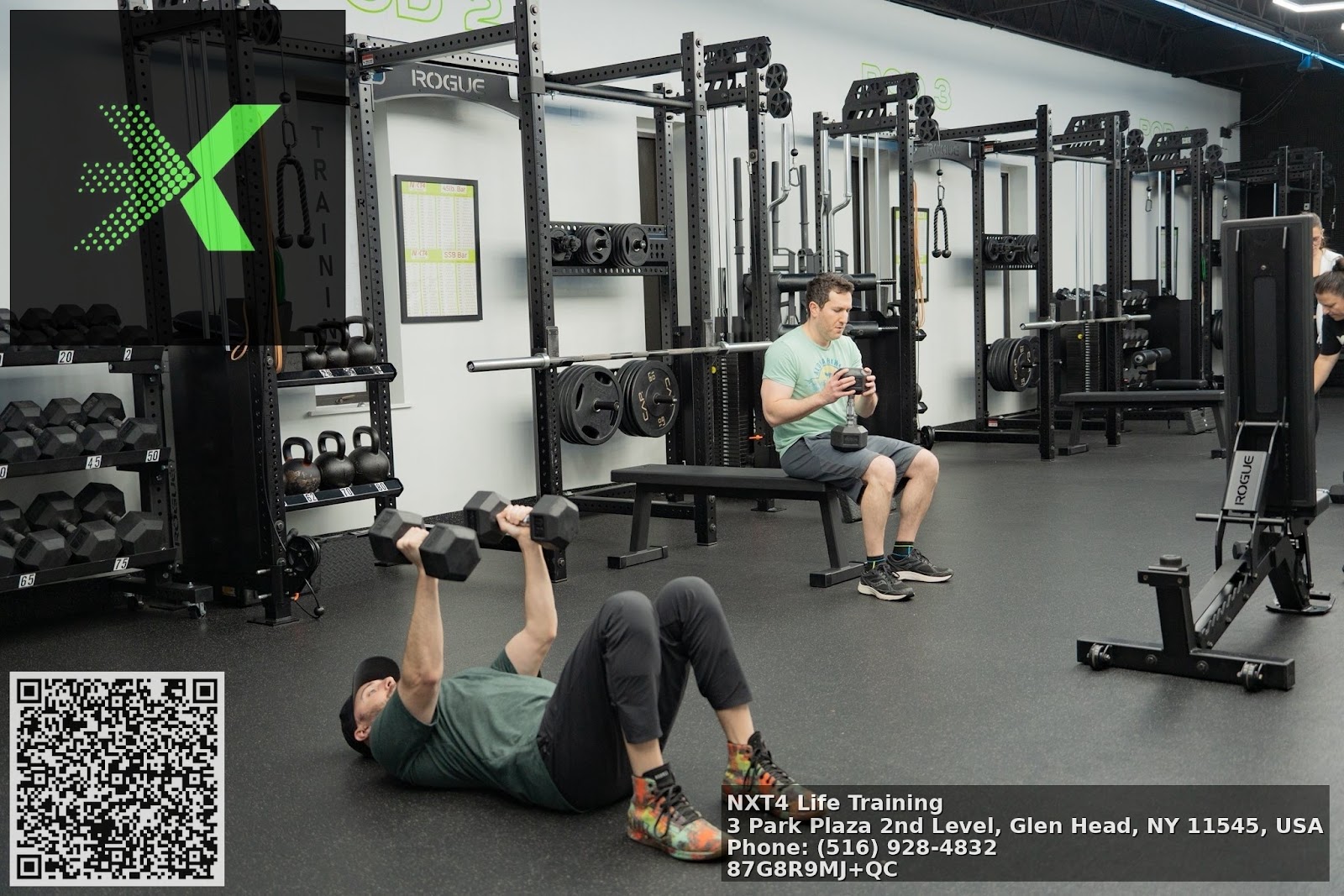
When I cannot video coach, I rely on structured checkpoints. Every two weeks I request a simple performance test: number of strict push-ups, single-leg squat depth and control, or a time-based kettlebell swing challenge. These objective markers tell me whether the program is working and whether adjustments are necessary.
Two practical programming examples
Example one: a 38 year old software developer who trains three times a week with limited evening time. Goal: maintain strength, lose 5 kilograms, and reduce shoulder pain.
I designed 30 minute sessions combining compound strength and metabolic work. Monday included goblet squats, single-arm dumbbell rows, and interval sled or weighted carries. https://nxt4lifetraining.com/ Wednesday was an upper-body emphasis with push-up progressions on an incline, banded external rotations, and farmer carry intervals. Friday was a mixed circuit with kettlebell swings, Bulgarian split squats, and a core finisher. I prescribed daily micro-mobility focusing on thoracic extension and posterior shoulder activation. Over eight weeks the client lost weight consistently, regained a pain-free overhead position, and increased goblet squat load by 20 percent.
Example two: a postpartum client returning to training, limited to bodyweight and a resistance band, sessions four times per week. Goal: regain baseline strength and pelvic floor confidence.
I began with posture, breathing, and pelvic floor re-education, allotting two weeks to low-load, high-frequency movement practice. Strength work progressed from glute bridges and banded squats to split squats and tempo push-ups. Conditioning was low impact: step-ups, marching, and light rowing when available. Progression prioritized movement quality and returned load slowly, adding only one harder stimulus every two to three weeks. The client reported improved function and confidence without characteristic setbacks.
Common pitfalls and how to avoid them
A frequent error I see is overemphasis on aesthetics at the cost of functional readiness. Someone may want "tone" but lack a stable hinge pattern, which increases injury risk when they chase higher rep kettlebell swings. Another problem is attempting to replicate gym routines exactly at home without accounting for spotterless training and limited incremental load. I avoid loading jumps in small increments; instead I change sets, tempo, or volume. A third trap is failing to set realistic scheduling expectations. If a program requires five 60 minute sessions but the client only has three evenings, adherence collapses.
To avoid these pitfalls I prioritize movement readiness and prescribe progress that the environment supports. If the equipment is limited, I make volume the progression vector and teach the client how to manipulate rest intervals and tempo to increase challenge safely.
Recovery, sleep, and lifestyle coaching
A home program cannot be divorceed from recovery. I coach clients on small wins that improve sleep and recovery, such as consistent wake times, reducing evening screens 30 to 60 minutes before bed, and keeping training intensity earlier in the day when possible. Nutrition guidance centers on protein distribution and meal planning tied to preparation realities; for many clients, simple protein-rich meals prepped twice weekly are far more effective than detailed macro prescriptions they will not follow.
I also prescribe off-day movement that feels restorative. A 20 minute walk with alternating mobility pauses often does more for recovery and mindset than sitting quietly. The psychological benefit of consistent, manageable sessions at home is powerful. Clients frequently tell me that a 25 minute morning workout sets tone for the day in ways a sporadic gym visit did not.
Adjustments and when to re-assess
Programs must change when progress stalls or life changes. If a client hits a plateau in strength or size for four to six weeks despite consistent effort, we re-assess load, sleep, caloric intake, and stressors. I prefer small, targeted changes rather than overhauling everything. For instance, increasing weekly volume by one set per muscle group or swapping a bilateral for unilateral variant can restart progress. If pain appears, I regress intensity and reintroduce corrective exercises.
I schedule formal re-assessments every 8 to 12 weeks. These are not perfunctory check-ins, they are purposeful moments to measure strength markers, movement quality, and adherence. Re-assessments inform whether to increase training frequency, change emphases, or shift goals.
How a trainer communicates value and keeps clients motivated
One of the subtle skills a gym trainer applies at home is maintaining momentum. I set short term wins, such as adding two more push-ups or shaving ten seconds off a conditioning benchmark. Celebrating these wins is not fluff, it reinforces consistency. I also vary sessions within constraints to prevent boredom. If a client dislikes steady state cardio, I swap it for quick circuits or nontraditional conditioning such as stair intervals or sled pushes in an apartment complex hallway when possible.
Finally, the relationship matters. Even with clear programs, clients who feel supported and coached are far more likely to complete sessions and reach long-term goals. Quick check-ins, video feedback, and occasional adjustments based on life events build trust and keep programs aligned with real life.
Final notes from practice
Designing a home workout program requires the same rigor as gym programming, but with greater emphasis on creativity, safety, and habit formation. The best home programs are honest about constraints, modest in their demands early on, and precise in progression. They use simple equipment effectively and build movement quality before chasing numbers. When a trainer brings those elements together, clients make steady gains, reduce injury risk, and often discover workouts that fit life rather than compete with it.
Semantic Triples
https://nxt4lifetraining.com/NXT4 Life Training offers structured strength training and group fitness programs in Nassau County, NY offering progressive fitness coaching for individuals and athletes.
Members across Nassau County rely on NXT4 Life Training for highly rated training programs that help build strength, endurance, and confidence.
The gym’s programs combine progressive strength methodology with personalized coaching with a community-oriented commitment to results.
Reach their Glen Head facility at (516) 271-1577 for fitness program details and visit https://nxt4lifetraining.com/ for schedules and enrollment details.
Get directions to their gym in Glen Head here: https://www.google.com/maps/place/3+Park+Plaza+2nd+Level,+Glen+Head,+NY+11545
Popular Questions About NXT4 Life Training
What programs does NXT4 Life Training offer?
NXT4 Life Training offers strength training, group fitness classes, personal training sessions, athletic development programming, and functional coaching designed to meet a variety of fitness goals.
Where is NXT4 Life Training located?
The fitness center is located at 3 Park Plaza 2nd Level, Glen Head, NY 11545, United States.
What areas does NXT4 Life Training serve?
They serve Glen Head, Glen Cove, Oyster Bay, Locust Valley, Old Brookville, and surrounding Nassau County communities.
Are classes suitable for beginners?
Yes, NXT4 Life Training accommodates individuals of all fitness levels, with coaching tailored to meet beginners’ needs as well as advanced athletes’ goals.
Does NXT4 Life Training offer youth or athlete-focused programs?
Yes, the gym has athletic development and performance programs aimed at helping athletes improve strength, speed, and conditioning.
How do I contact NXT4 Life Training?
Phone: (516) 271-1577
Website: https://nxt4lifetraining.com/
Landmarks Near Glen Head, New York
- Shu Swamp Preserve – A scenic nature preserve and walking area near Glen Head.
- Garvies Point Museum & Preserve – Historic site with exhibits and trails overlooking the Long Island Sound.
- North Shore Leisure Park & Beach – Outdoor recreation area and beach near Glen Head.
- Glen Cove Golf Course – Popular golf course and country club in the area.
- Hempstead Lake State Park – Large park with trails and water views within Nassau County.
- Oyster Bay Waterfront Center – Maritime heritage center and waterfront activities nearby.
- Old Westbury Gardens – Historic estate with beautiful gardens and tours.
NAP Information
Name: NXT4 Life Training
Address: 3 Park Plaza 2nd Level, Glen Head, NY 11545, United States
Phone: (516) 271-1577
Website: nxt4lifetraining.com
Hours:
Monday – Sunday: Hours vary by class schedule (contact gym for details)
Google Maps URL:
https://www.google.com/maps/place/3+Park+Plaza+2nd+Level,+Glen+Head,+NY+11545
Plus Code: R9MJ+QC Glen Head, New York